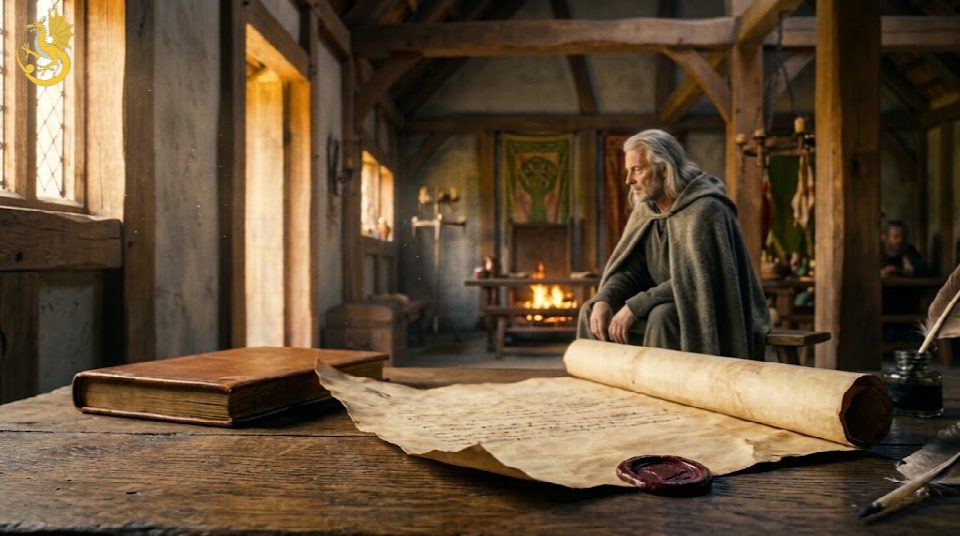
Join Goldie the Grey on an enthralling journey through Ceredigion, where the threads of family history, ancient land rights, and the relentless pursuits of Whitehall converge at Mwnt.
This narrative is a fictional creation, intricately woven around genuine locations, lived experiences, and genealogical investigations. Evidence tags denote particular genealogical or traditional elements; they do not validate the fictional events or legal claims made herein.
Outsmarting Authorities: Goldie’s Ingenious Escape Plan
After the ultimatum from the Senedd in Cardiff Bay, the political climate shifted abruptly from open dialogue to clandestine tactics.
In Whitehall and Cardiff, secured conference rooms buzzed with urgent strategy sessions. Local law enforcement received covert instructions to observe Goldie’s movements near historical landmarks and ancient common lands.
Perched on a windswept ridge that overlooked the Conwy Valley, Goldie the Grey stood still while dark storm clouds loomed overhead. He observed the distant lights of towns in the valley flickering to life below.
He felt no trepidation in the face of the impending legal storm. He understood that the corporate state would fiercely defend its multi-billion-pound interests.
The wind howled through the heather, tugging at his heavy grey cloak. In his weathered hand, he clutched a fresh, unsealed parchment.
Aware that police units were patrolling the main thoroughfares and tourist car parks, Goldie opted to abandon the tarmac.
He navigated ancient sheep tracks, moving with the stealthy grace of a man who recognised that true navigation relies on the landscape rather than road signs.
His ultimate aim was Aberystwyth.
At the Penglais campus, Professor Elinora Vance diligently prepared a comprehensive academic memorandum. This document would soon be in Goldie’s possession, equipping him with the intellectual means to counter Whitehall’s legal claims.
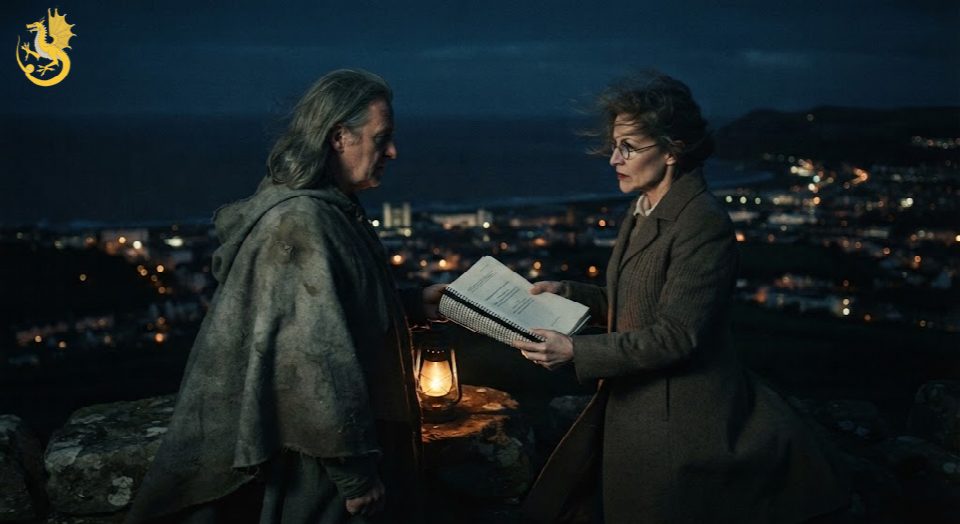
After days avoiding busy routes, he finally met Vance in the shadow of an Iron Age hillfort that overlooked Cardigan Bay.
She handed him a thick, tightly bound manuscript.
This document compiled centuries of customary tenure, charter ratifications, and pre-Conquest immunities into a compelling argument that Vance believed could dismantle Whitehall’s claims.
Armed with this intellectual defence, Goldie turned southward, evading the surveillance surrounding the town as he continued through Ceredigion.
Navigating Coastal Cliffs: Goldie’s Secret Journey to Llangrannog
Departing Aberystwyth, Goldie steered clear of the main roads, where automatic number plate recognition cameras and patrol vehicles vigilantly searched for his presence.
Instead, he opted for the rugged coastal path, tracing the edge of Cardigan Bay, where steep cliffs plunged into the churning blue waters below.
Freedom along the coast proved to be an illusion. Far behind, two figures clad in dark, utilitarian gear maintained their distance, silently tracking his every movement.
Occasionally, the faint whir of a surveillance drone announced its presence overhead. Goldie could not ascertain whether it belonged to the state or its corporate allies.
He maintained a steady pace, using the terrain to his advantage, disappearing behind craggy headlands whenever the drone approached too closely.
After two more days navigating the coastal paths, he reached Llangrannog in the late afternoon.
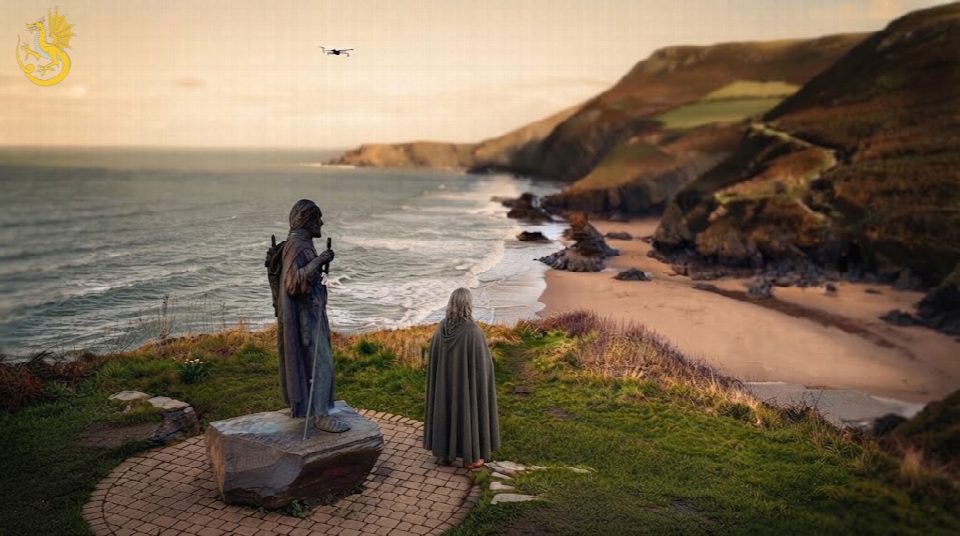
Overlooking the beach and the crashing surf, the life-size bronze statue of Saint Carannog, crafted by Sebastien Boyesen, stood sentinel.
Goldie paused beside the statue, gazing toward the shore where, according to tradition, the sixth-century saint arrived by sea to spread his ministry. Tradition
Meandering Through Enclosed Lanes and Woodland Trails
The following morning, Goldie veered inland, leaving the coastal trail for sunken country lanes shrouded by ancient hedgerows of hazel and hawthorn.
These earthen corridors provided ample shade and a welcome reprieve from the intrusive electronic surveillance above.
Whenever the lane widened, he slipped into tranquil woodlands, treading softly on carpets of fallen leaves and damp moss beneath the arching boughs of pine and oak.
Dappled sunlight filtered through the canopy, illuminating the moist leaves that muffled his footsteps, while intertwined branches concealed him from aerial observation.
He glided through the timberlands like a spectre, crossing mossy stream beds and following age-old paths etched into the earth.
Occasionally, the low hum of a drone drifted above the treetops. Goldie paused beneath the branches until the sound faded and then continued toward the serene valleys of his childhood.
Finding Solace in Glynarthen
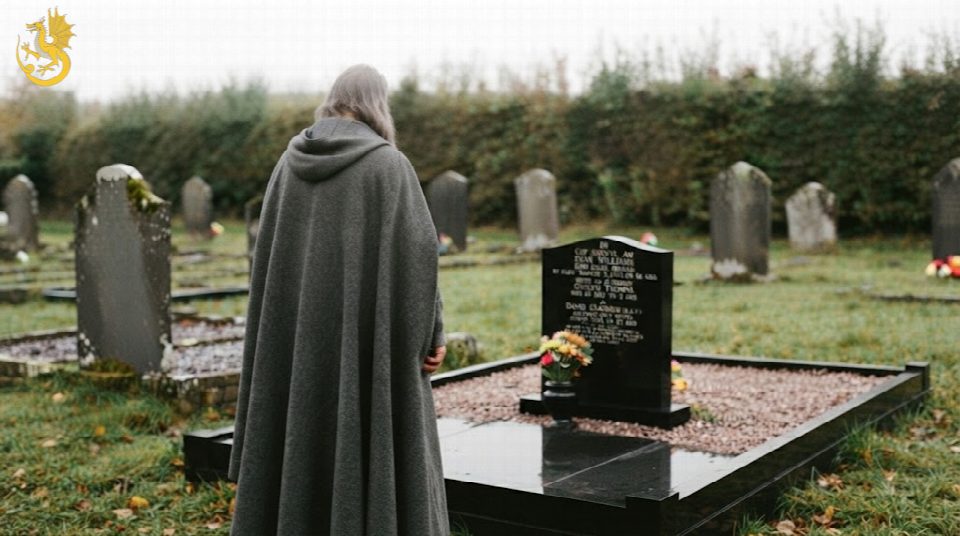
Goldie emerged from the shaded forest paths into the lush, rolling countryside that enveloped Glynarthen.
For the wanderer whose mother was named Arianwen, this soil held sacred significance. To him, her name embodied the brilliance of white silver.
From that maternal heritage, he had embraced his own name of gold, crafting an identity that resonated with the ancient wealth of the earth beneath his feet.
In the local churchyard rested the remains of his ancestors.
Goldie stood beside the polished black headstone, taking a moment to reflect on the generations that connected his family to this land.
The church and its community held memories of both joy and sorrow.
Decades prior, the church had celebrated a double wedding in his family, with attendees journeying from afar to honour two brides whose lineage, chronicled in the family pedigree, traced back to Rhodri Mawr. Genealogies
The weight of memory hung heavily in the soft autumn air.
Goldie traced the inscriptions with his fingers, recalling extensive research conducted in graveyards and county record offices.
The family’s documented lineage extended thirty-five generations back to Rhodri Mawr, preserved in a handwritten family tree scroll. Genealogies
In Glynarthen, amidst the quiet testament of past generations, Goldie felt the enduring essence of Lex Terrae.
The state may issue statutory writs and freeze transactions, but it cannot erase the blood, sweat, and memories of families who have nurtured and protected these lands for centuries.
Here, surrounded by yew trees and inscribed granite, he offered a silent prayer of gratitude. He renewed his vow to safeguard the community’s customary rights against corporate encroachment.
Honouring the Legacy of Glasgoed and the Bardic Heritage
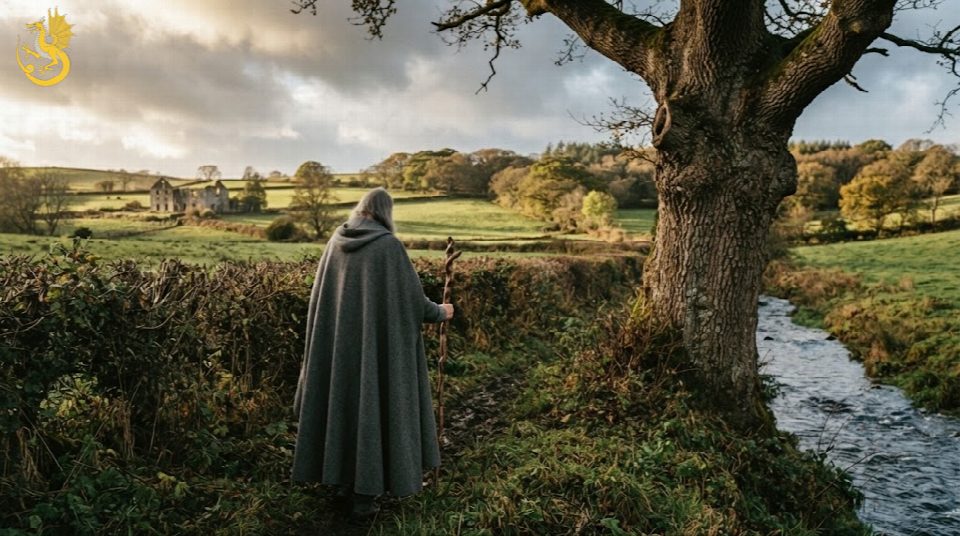
Goldie left Glynarthen, following the sunken boundary lanes toward Glasgoed.
The old estate was deeply connected to his maternal lineage. His family’s roots ran deep in this landscape of ancient woodlands, stone-walled homesteads, and fierce self-reliance.
Glasgoed was more than a mere name on a map; it was a place whose inhabitants and stories had been immortalised in poetry.
Dic Jones, the esteemed bard from West Wales, had encapsulated its spirit through his verses.
Among the documents Goldie carried was an original handwritten copy of Dic Jones’s poem dedicated to the estate—a tangible link between the poetic essence of Wales and the struggle unfolding around him.
As Goldie circled the perimeter of the old estate, he noted how modern agricultural intensification and absentee corporate ownership had begun to fracture the region’s historical unity.
Yet the landscape remained resolute. Ancient oaks marked forgotten boundaries, and streams flowed along courses that no surveyor’s pen could alter.
As he traversed these familiar yet long-unwalked paths, Goldie realised that the essence of Lex Terrae resided in the fields themselves.
It represented a living social contract between the inhabitants and the land. While Professor Vance’s memorandum provided the legal framework, Glasgoed embodied the reason he could not simply walk away.
Every hedgerow and stone stile recalled a community shaped by tradition, cooperation, and mutual respect.
Contemplating at Aberporth
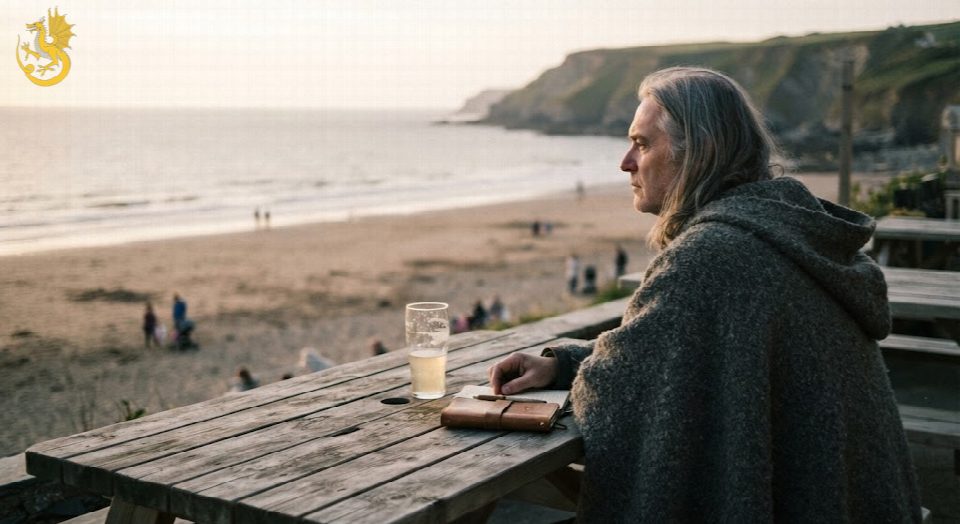
After departing Glasgoed, Goldie again turned towards the sea.
At Aberporth, another childhood haunt, he paused at The Ship for a refreshing pint of cider while gazing over the bay.
In the salty breeze, he reminisced about his youth filled with motorcycles, romantic escapades, and the thrill of rock music.
He pondered his transformation into a mystic bard, reflecting on how life had guided him to this pivotal moment.
The roar of engines and the vibrancy of youth felt like a distant echo. Yet every twist and turn of his journey had led him back to these cliffs, bound by blood and history to the land he now vowed to protect.
Ascending the Hill of Death: A Climactic Moment Unfolds
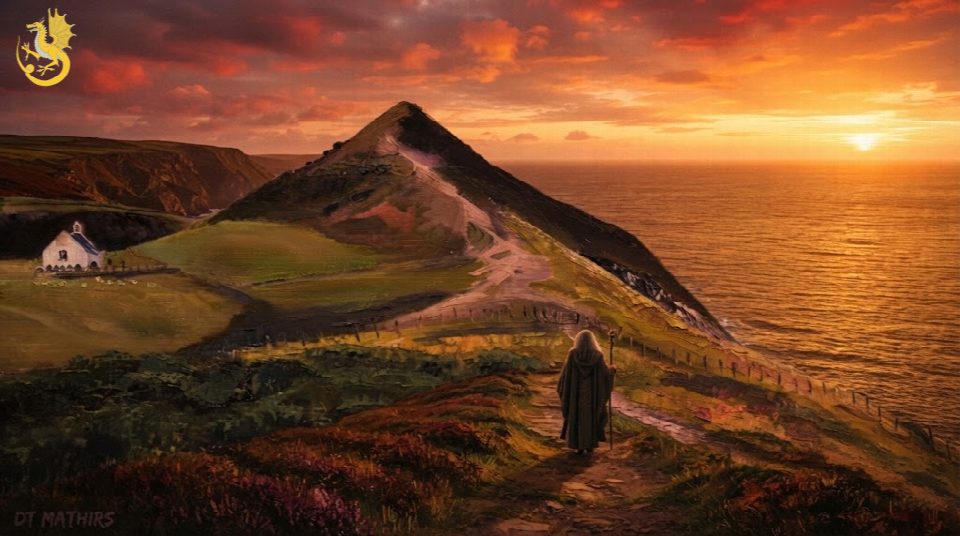
Later that afternoon, with Vance’s dossier in hand, Goldie continued toward Mwnt, where the verdant headland rose majestically above Cardigan Bay.
Sea-battered cliffs framed the coastline. Below, the small, whitewashed Church of the Holy Cross nestled against the hill.
Foel y Mwnt loomed directly behind it, its grassy slopes ascending above the church and the bay.
Goldie had a personal name for it: the Hill of Death.
The shore below held memories of conflict; local tradition recounts how Welsh defenders repelled a Flemish invasion here in 1155. The bloodshed is remembered in the name Sul Coch y Mwnt—Red Sunday of Mwnt. Tradition
Goldie began his ascent as the late afternoon sun dipped towards the western horizon, casting amber light across Cardigan Bay.
The climb was physically demanding, yet he maintained a steady rhythm. His heavy grey cloak billowed in the maritime wind.
Below him, the tiny church stood resolute against the restless sea, a quiet guardian of faith and endurance.
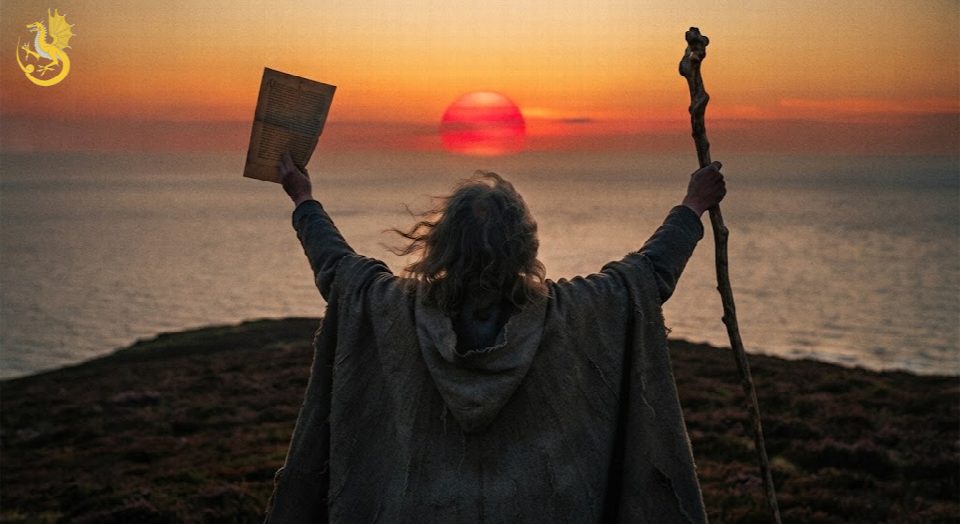
Goldie reached the summit of Foel y Mwnt. He stood alone, suspended between the roaring sea and the darkening Welsh sky.
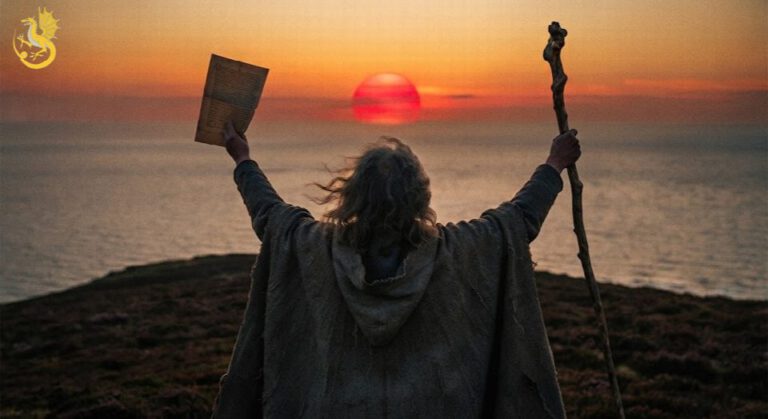
His heavy cloak enveloped him as he faced the dying sun. He raised both arms against the crimson sky, gripping his gnarled wooden staff in his right hand and Professor Vance’s memorandum in his left.
Before the sea and encroaching darkness, he held them aloft: one symbolising the land he walked, the other representing the cause he championed.
Crashing waves echoed far below. A fiery sunset painted the ocean in hues of crimson and gold.
With both arms raised high, Goldie offered a silent prayer, dedicating his struggle and the ancient rights of the Welsh people to divine justice and eternal stewardship.
As the Trap Closes at the Church of the Holy Cross
Peace at the summit shattered abruptly.
The distant rumble of engines rose from the narrow coastal approach road.
Below, several Dyfed-Powys Police 4x4s and specialised response vans came to a halt near the boundary wall of the Church of the Holy Cross.
Doors slammed shut. Officers spread out around the approaches to the headland. A megaphone crackled to life.
“Mr Grey, this is the police. Please descend slowly and keep your hands visible.”
The amplified voice echoed across the slopes.
“You are surrounded. Comply with our instructions.”
Goldie surveyed the scene below with complete composure. He did not seek an escape through the gorse-choked gullies. He recognised that his journey on these open lands had reached its destined boundary.
Rather than waiting for the officers to reach him, he lowered his arms. Keeping his staff and Vance’s memorandum in view, he began his descent along the winding path of Foel y Mwnt.
He walked steadily towards the waiting authorities.
This was not a march to his death, nor a mere surrender to temporary custody.
For Goldie, it was an act of submission to a higher authority and the enduring will of God.
Incarceration would not silence the movement, and martyrdom was unnecessary. The truth had already taken root in the earth.
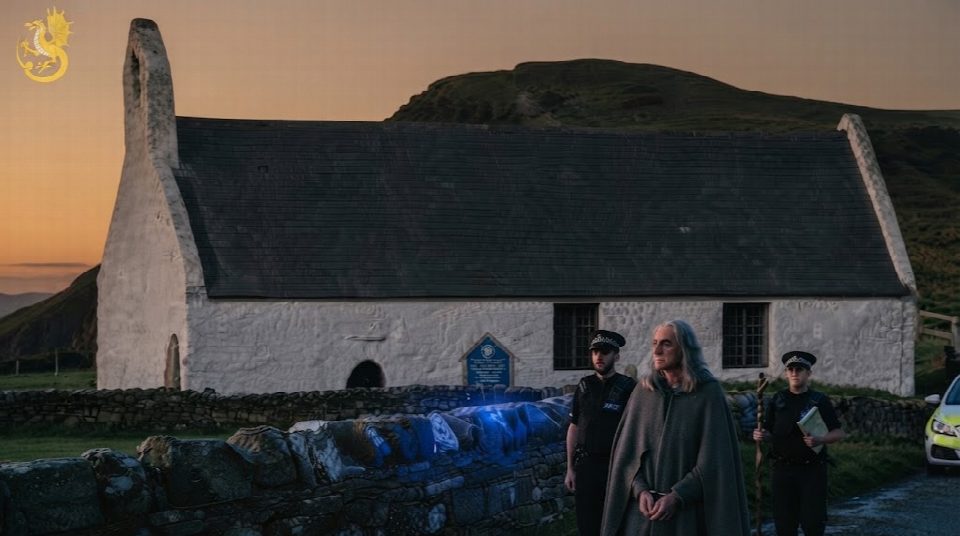
At the boundary wall of the Church of the Holy Cross, he handed an officer his staff and Vance’s memorandum.
Then he extended his hands.
The handcuffs clicked into place around his wrists.
Yet as the patrol vehicles escorted him away from the coast into the encroaching night, Goldie felt a profound sense of peace.
The parchment had been entrusted to the law.
The land had embraced its son.
The narrative of Lex Terrae was no longer his alone to bear.
Peace, Prosperity, Patience & Justice Under God.
Clarifying the Line Between Fiction and Reality
Goldie’s journey, Professor Vance, the surveillance operation, the legal memorandum, and the arrest are entirely fictional. This narrative draws inspiration from authentic Welsh locations, personal memories, and genealogical research.
The genealogical labels identify relationships recorded in the family pedigree, rather than independently verifying every generation. In the wedding passage, the label pertains to the ancestry documented in that pedigree, not to documentary verification of the wedding itself.
Traditional accounts are separately labelled. Personal memories and family-held material are presented as such without a documented label.
The story’s interpretation of Lex Terrae forms part of its fictional argument, rather than a statement of established legal rights.
The post Ancestors’ Path: Episode 4 Unveiled appeared first on Limits Of Strategy.